Intelligence you can act on, and defend.
SameGROUND puts the most capable AI through a governed method before you are asked to trust a word of it. Every claim is graded and sourced. Nothing is overstated. And it shows you where the public record and your own evidence disagree, so the decisions that affect people, budgets and reputations hold up under challenge.
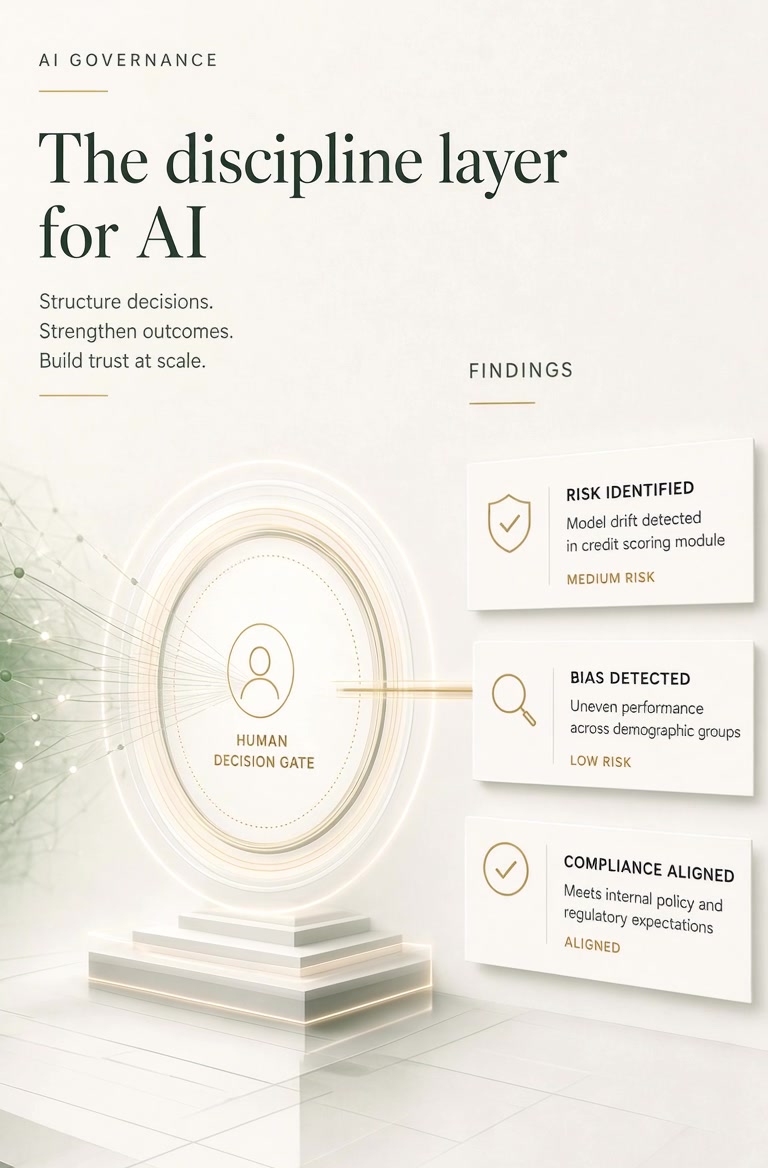
Confident is not the same as correct.
AI now writes fluently, answers instantly, and is wrong often enough to matter. The more capable it becomes, the more convincing its mistakes are. It also drifts: small, reasonable-looking changes build up across a piece of work until the picture no longer matches the situation it describes, and nothing in the output tells you it has happened.
For a quick task, that is a nuisance. For a decision that commits money, affects a person, or will be examined later, it is a liability. You do not need a confident answer about a council decision. You need to know what is proven, what is inferred, what is missing, and whether the whole thing survives someone trying to take it apart.
A discipline layer, not another chatbot.
SameGROUND is a method and an architecture that sits above today's leading AI models and holds their reasoning to a standard. It rides on the best model available and gets better as the models do, and it never lets them drift or overreach. The discipline is the product.
Graded, not asserted
Every finding is labelled for how strongly the evidence supports it, from what is shown in the record, to what is a reasonable reading, to what is still an open question. You see the strength of each claim without taking anything on faith.
A diagnosis, not a verdict
SameGROUND will not hand you a score or a ruling it has not earned. It sets out what the evidence supports and leaves the decision with you, with the reasoning in the open. You stay the decision maker.
Enforced, not requested
The discipline is built into the system in code. It cannot fabricate a source, invent certainty, or claim more than the evidence carries, whatever the underlying model tries to do. Where most tools ask the model to behave, SameGROUND makes it.
Ask a hard question. Two ways to answer.
A supplier asks you to renew a large managed-services contract. Here is a typical AI answer, and here is a SameGROUND finding on the same evidence.
Is this supplier reliable enough to renew?
Confident answerYes. Based on the available information, this supplier has a strong delivery record, positive market standing, and no significant red flags. They are a reliable, low-risk partner.
Recommendation: proceed with renewalFluent, fast and confident. It does not tell you what it could not check, how sure it is, or where the picture might be wrong. If the renewal goes badly, none of this survives a review.
Illustrative example. The figures are invented to show the shape of a finding, not drawn from a client matter.
A search tool, a consultant, and SameGROUND.
Each row is a choice we made on purpose. The last one is the one no other tool can copy.
| An AI research tool | A consultant or internal team | SameGROUND | |
|---|---|---|---|
| Gives you | A fluent, confident answer | One considered view | A graded, sourced diagnosis |
| Tells you how sure it is | Rarely | Sometimes | On every claim |
| Shows what it could not find | No | Sometimes | Always, as a named gap |
| Hands down a ruling | Yes, readily | Yes | No, by design. You decide |
| Reads you inside and out | One side only | One side only | Both, and shows the divergence |
| Holds up when challenged | Weakly | Depends on the person | Built to be contested |
Everything above the last line, a better model can narrow. The last line it cannot, because it needs both sides of the picture at once.
See yourself from the outside and the inside at once.
Most tools see one side. A research tool sees only what is public. Your own people see only what is internal. The risk usually sits in the space between them. SameGROUND runs the same disciplined method on both, and hands you the distance.
Public filings report on-time delivery at 98% across two years.
Award announcements describe a strong and improving track record.
No independent audit of the delivery data is public.
What the public record shows about the subject, graded and sourced.
Illustrative example. The figures are invented to show the shape of a finding, not drawn from a client matter.
What the discipline actually does.
The method is proprietary and patent pending. What you see below is the discipline it enforces, not the machinery that does it.
Researches to exhaustion
It keeps going until fresh searching stops turning up anything new, so the picture is as complete as the record allows. It says what it deliberately set aside.
Grades and sources every claim
Each finding carries its strength and its evidence. Copied and syndicated sources are not counted twice, so agreement means genuinely independent agreement.
Names what it cannot see
A missing fact is recorded as a gap, not smoothed over and not treated as false. You are never left mistaking silence for proof.
Stops at the gate
Nothing is presented as settled, and nothing is acted on, until a named person with the standing to decide has signed it off. The method attends. A person decides.
Not a chat transcript. A record you can use.
The output is a structured evidence pack: the findings, each labelled and sourced; the gaps, named; the fixes or next steps, tied to what can actually be done; and, where it applies, the exact questions and requests to send to the people who hold the missing pieces. It reads as work a professional in your field would recognise as their own, and it is built to be handed on, examined and defended.
Evidence pack · Finding 07 of 44
One method. Ways to put it to work.
The same discipline, proven in very different domains.
SameGROUND Diagnostics
The full method applied to a decision, a body, or a system. A sourced, graded diagnosis you can act on and defend, from the outside record, your inside evidence, or both together.
Explore Diagnostics →VoiceMark
The same discipline for writing. It reads a piece against a voice you choose and shows how close it is, and it can assess authorship as a careful, opt-in finding that never becomes a number or an accusation. The writer stays the decision maker.
Explore VoiceMark →Built on published research. Patent pending.
SameGROUND did not start as a product. It started as a body of research into why capable systems lose contact with reality, and how to stop it. The method that came out of that work is the subject of pending patent applications, and the thinking behind it is published and open to scrutiny. We hold ourselves to the same standard we sell: we tell you what we can support, we name what we cannot, and we do not overstate.
Read the thinking →Patent-pending method
Applications GB2606513.6 and GB2607929.3.
Published research
The reasoning is open to scrutiny.
Held to its own standard
Graded, sourced, never overstated.
When the decision matters, that is why SameGROUND exists.
You do not need an answer that sounds right. You need one that is graded, sourced, honest about its gaps, and able to survive being challenged, on top of the best AI there is, held to a standard it cannot bend.
Start a diagnostic